Box-line reduction: the pointing pair, read backwards
The Sudokumania team ·
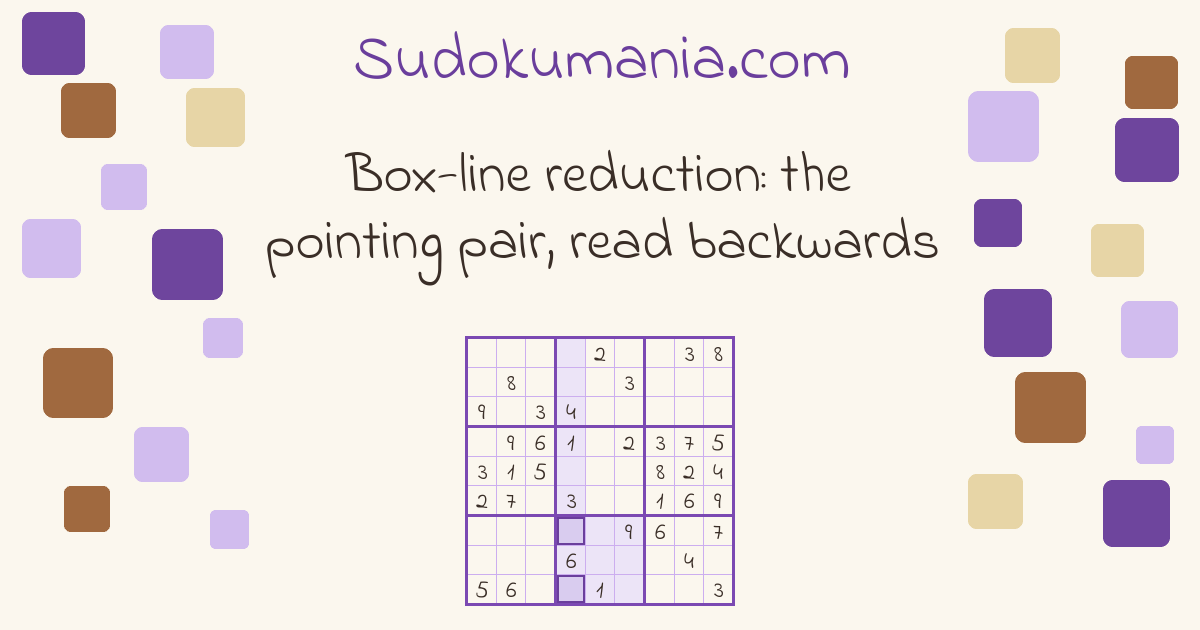
The pointing pair starts from a box and looks along a row. The technique in this guide goes the other way: it starts from a row, or a column, and looks inside a box. It's called box-line reduction (or also claiming) and, like the pointing pair, it doesn't write a number: it removes one from some cells. In medium sudoku it can be the move you need when scanning, singles and the pointing pair find nothing more.
The idea
Every row crosses three boxes, three cells in each. Suppose that in a row the 7 isn't there yet and can only go in two cells, both inside the same box. You don't know yet which of the two is the right one, but one thing you already know: the 7 of that row will be there, inside that box. And a box has only one 7. So, in the same box, outside the row, the 7 can't go.
The row “reduces” the places for the 7 in the box: it removes it from the other six cells of the box. The possible cells can be two or three, always inside the same box, and the reasoning is identical; if there's only one, it's a hidden single, and you write the number right away. And everything works the same way for columns: the two examples in this guide are in fact in a column.
It's the same intersection as the pointing pair, that is the three cells where a box and a row (or a column) cross, read from the other side. In the pointing pair the cells are the only places for the number in the box, and the number is removed from the rest of the row. Here they're the only places for the number in the row, and the number is removed from the rest of the box.
A step-by-step example
Here's how you get there:
- Pick a column and a number that isn't in it yet. Columns with many numbers already written have few empty cells and are quicker to check. With a row you do the same.
- Rule out cells in the column. For each empty cell look at its row and its box: if either of them already contains the number, the number can't go there. (If you start from a row, you look at the column and the box.)
- See whether the cells left are in a single box. A column is made of three pieces of three cells, one per box: if the cells left, two or three, all fall in the same piece, you've found the reduction.
- Remove the number from the rest of the box. In the cells of that box outside the column the number can no longer go: if you use notes, erase it from there; if you don't, remember it when you scan that box.
The elimination alone doesn't fill any cell. But the cells of the box that have lost a candidate are good places to look: sometimes one of them is left with only one possible number, sometimes another row or column that crosses the box has one place fewer for that number, and only one is left.
With pencil marks
With notes you see the reduction by following a number along a row or a column: if all its notes fall in the same box, you've found your intersection.
To spot it quickly:
- when you look for a pointing pair, look for the inverse too: you're already looking at the rows and columns that cross the box, and the two techniques sit at the same crossings;
- look for rows and columns where a number has few notes, two or three: if they fall in the same third of the line, they're in the same box;
- after every elimination go back to the singles: that's usually where the new number turns up.
The most common mistakes
- Forgetting a cell. Before removing the number, check the whole row or column, including the cells in the other two boxes it crosses: a single possible cell outside the box and the reduction is gone. With notes, keep them up to date: a missing note makes you see a reduction that isn't there, and the elimination that follows is wrong.
- Removing it from the line instead of the box. The number is removed from the other cells of the box. In the rest of the row, or column, it's already ruled out: that's exactly why you found the reduction.
- Removing it from the marked cells too. In the cells of the row, or column, inside the box the number stays: one of them will hold it.
- Mixing it up with the pointing pair. The two techniques look at the same crossing, so ask yourself where you started from. If the cells are the only places for the number in the box, you remove it from the rest of the row (or column): that's the pointing pair. If they're the only places for the number in the row (or column), you remove it from the rest of the box: that's box-line reduction.
When you need it, on Sudokumania
At every step our solver tries the techniques from the simplest: first the singles, then the intersections (first the pointing pair, then box-line reduction), then the pairs, the triples and the others. The two intersections have the same level: a sudoku is medium when, to solve it, the solver uses an intersection at least once and nothing harder. So in medium ones, when the singles and the pointing pairs find nothing more, the move that unlocks the grid may be exactly this one. In hard ones you'll use it often, before getting to the more complicated techniques.
More guides
- Scanning (cross-hatching): the first sudoku technique Scanning, or cross-hatching, is the technique that solves almost every easy sudoku. How it works, a real example and how to do it quickly. Easy
- Naked single and hidden single: the two moves behind every sudoku A number is forced in two ways: the cell admits no other, or the number has no other place in its row, column or box. Here's how to spot them. Easy
- Pointing pairs and triples: the first technique of medium sudoku If a number in a box can only go in one row or column, you remove it from the rest of that line. How to spot it, with two real examples. Medium