Scanning (cross-hatching): the first sudoku technique
The Sudokumania team ·
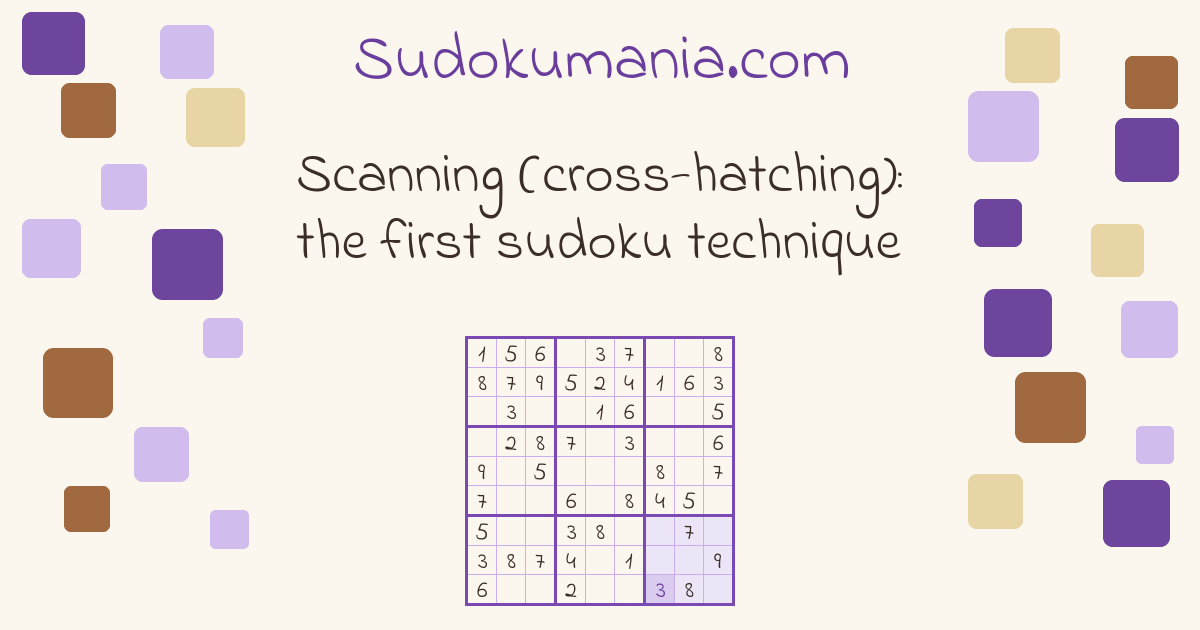
If you only had to learn one technique, this would be the one. Scanning, also called cross-hatching, solves easy sudoku almost on its own, and it stays the move you'll use most even in hard ones. It needs no notes and no memory: just your eyes and a little method.
How it works
Pick a number, say 7, and a box where the 7 isn't there yet. The 7 will have to go in one of its empty cells. Now look at the three rows that cross the box: if one of them already has a 7 outside the box, no cell in that row can hold another 7. Do the same with the three columns.
The “occupied” rows and columns cut across the box like hatching, which is where the name comes from. If after the cutting there is only one free cell left, the 7 goes there.
Why it works: the box must contain a 7, and the rules forbid two 7s in the same row or column. If every cell but one is forbidden, the one that's left is forced. It's certain reasoning, not a hunch.
Not just in boxes
The same reasoning works for rows and columns. Take a row that's missing the 4: each of its empty cells is ruled out if its column already has a 4, or if its box already contains one. If only one cell is left, that's where the 4 goes.
In easy sudoku, scanning the boxes is almost always enough. Rows and columns become useful when the boxes are all “stuck”.
How to do it quickly
- One number at a time. Pick the number and go round the nine boxes, left to right and top to bottom. Then move on to the next number. It's faster than looking at one box at a time with all the numbers.
- Start with the most frequent numbers. A number that already appears seven times has only two places left to find, and almost all the cuts are already made.
- Look at the sets of three boxes. The boxes form three horizontal and three vertical “bands”. If, in a horizontal band, the 7 is already in two boxes, in the third it can only go in the row that's still free: scanning becomes instant.
- Start again often. Every number you write creates new cuts. After two or three new numbers, go back to the beginning of the round.
When it isn't enough
Sometimes, after the cutting, two or three possible cells are left in the box. Don't choose at random: it means you need another point of view. Try looking at the cell instead of the number (the naked single), or write the pencil marks for that number: two cells marked today can become just one tomorrow, once you've written a few more numbers.
On Sudokumania's easy sudoku, scanning and singles are always enough. On medium ones you start to need something more, but scanning stays the move you make most often.
More guides
- Next guide Naked single and hidden single: the two moves behind every sudoku A number is forced in two ways: the cell admits no other, or the number has no other place in its row, column or box. Here's how to spot them. Easy
- Pointing pairs and triples: the first technique of medium sudoku If a number in a box can only go in one row or column, you remove it from the rest of that line. How to spot it, with two real examples. Medium