Pencil marks in sudoku: when you need them and how to use them well
The Sudokumania team ·
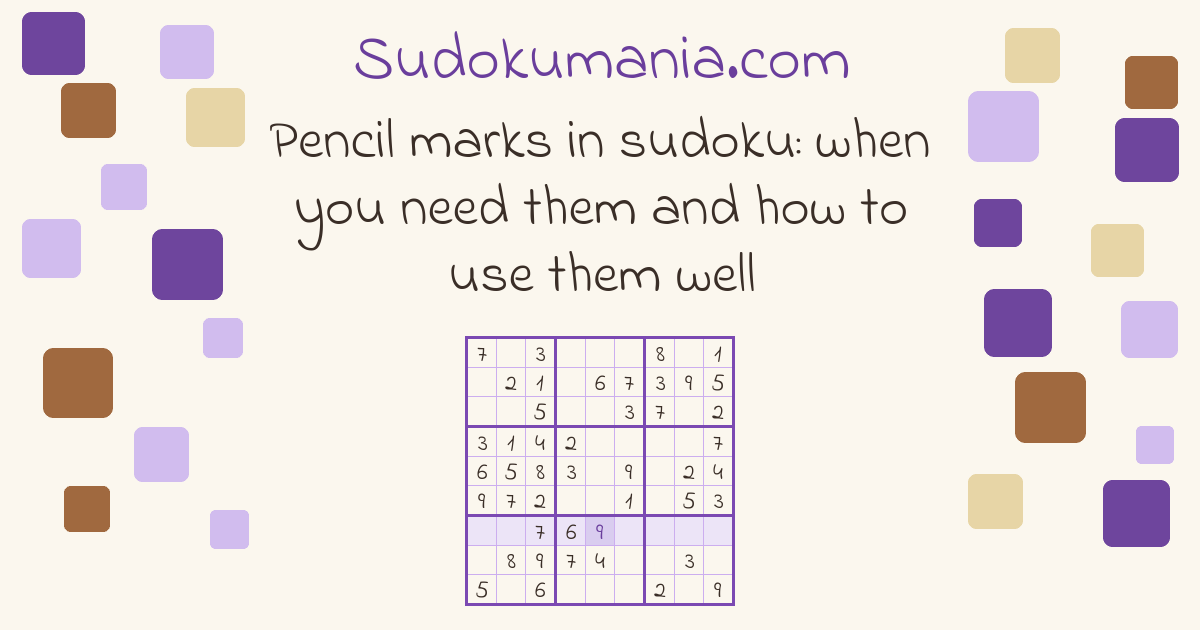
In easy sudoku you can get by with your eyes alone. In medium and hard ones, sooner or later, scanning stops and no cell has a forced number in sight. That's where pencil marks come in: the small numbers you write in a cell to remember which numbers can still go there. They're also called candidates.
Notes don't solve the sudoku on their own. They let you see what your memory can't hold all at once, and they're the material that all the more advanced techniques work on.
When to start
Not from the beginning. On a grid that's still almost empty, every cell would have six or seven candidates: writing them all takes time and produces a wall of unreadable numbers. First do everything you can with scanning and singles. When you're truly stuck, it's time for notes.
Two ways to use them
Full notes
For every empty cell you write all the numbers that don't already appear in its row, its column and its box. It's the safest method: afterwards, every move can be read straight from the notes. It costs a few minutes, and it's what you need for the techniques of hard sudoku, like pairs and the X-Wing.
Targeted notes
Many experienced players write a note only when a number, in a box, can go in just two cells. It's also called Snyder notation, after the American champion who made it famous. The notes are few, they can be read at a glance and they're enough for most medium sudoku. When they're no longer enough, you switch to full notes.
The advice: in medium ones start with targeted notes; in hard ones, when you get stuck, complete them.
Keeping them clean
A wrong note is worse than a missing note. Every time you write a number, remove it from the notes of its row, its column and its box. On Sudokumania the game does it for you; if you'd rather do it by hand, you can turn that off in Settings. When a technique tells you a candidate can't go in a cell, erase it right away: that's how you make progress in hard sudoku.
Reading the notes
With the notes written, some moves become obvious:
- a cell with a single note is a naked single: that number goes there;
- a number that, in the notes of a row, a column or a box, appears only once is a hidden single.
The second case is the easiest to miss, because the cell also has other notes. Get used to going through the units number by number, not just cell by cell.
And when two cells of the same unit have the same two notes, say 4 and 8, you've found a pair: those two numbers will go there, and you can remove them from the rest of the unit. It's the gateway to hard sudoku, and it will soon have a guide of its own.
Notes on Sudokumania
- Tap Notes to write in pencil: each number on the pad adds or removes the note in the selected cell.
- Or press and hold an empty cell: a small pad opens just for its notes.
- On a keyboard, Shift plus the number adds or removes a note, and N turns notes on and off.
More guides
- Next guide Pointing pairs and triples: the first technique of medium sudoku If a number in a box can only go in one row or column, you remove it from the rest of that line. How to spot it, with two real examples. Medium
- Sudoku for beginners: a method for never getting stuck How to solve a sudoku without guessing: where to start, in what order to look at the grid and what to do when you get stuck. Easy