Sudoku for beginners: a method for never getting stuck
The Sudokumania team ·
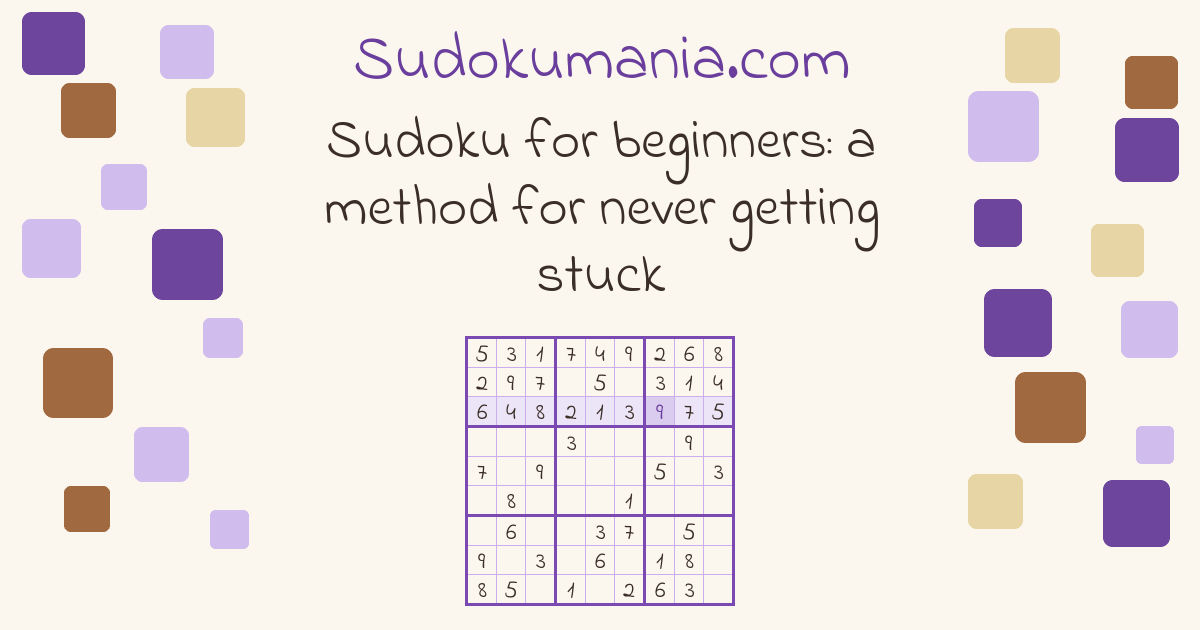
The rules of sudoku fit in one line: every row, every column and every 3 × 3 box must contain the numbers from 1 to 9, once each (you'll find them in full in How to play). The hard part is something else: faced with a grid full of empty cells, where do you begin? This guide gives you a simple method that works on every easy sudoku and prepares you for the harder ones.
The first rule: don't guess
Every well-made sudoku has exactly one solution, and you get there by reasoning. If you write a number because it “looks right”, sooner or later you end up with two equal numbers in the same row and no idea which move was the wrong one. Write a number only when you're sure it can't go anywhere else.
At first it feels slow. In fact it's the fastest way: an easy sudoku solved without mistakes takes a few minutes, while one full of guesses often never gets finished at all.
Start with the easiest cells
The last free cell
Look at the rows, columns and boxes that are almost full. If a unit is missing just one number, the empty cell is where it goes: all you have to do is work out which number is missing.
The numbers that are already there most often
Count how many times each number appears. If the 5 is already there seven times, only two are missing, and their places are almost forced: every 5 that's already written rules out its row, its column and its box. Always start with the numbers that appear most, then move on to the others.
Going round the boxes
This is the heart of the method, and it's called scanning. Pick a number and a box where it's missing. Look at the rows and columns that cross the box: wherever that number is already there, the cells of that row or column are ruled out. If only one cell is left, the number goes there.
Go round all nine boxes with the same number, then move on to the next number. Every number you write opens up new possibilities, so start again from the first number each time you've written a couple. The guide to scanning shows you how to do it quickly.
When scanning isn't enough: look at the cell
Sometimes no number has a single place, but a cell has a single number. Take an empty cell and look at its row, its column and its box: if together they already contain eight different numbers, the ninth is the right one. It's called a naked single, and we explain it together with its twin, the hidden single, in the guide to singles.
The method in five steps
- Fill in the units that are missing just one number.
- Count the numbers and start with the ones that already appear most often.
- For each number, go round the nine boxes with scanning.
- When you can't find anything more, look for cells with only one possible number.
- If you're still stuck, start writing pencil marks: they show you what you can no longer see by eye.
Every time you write a number, go back to step 1: that's usually where the rest comes unstuck.
The most common mistakes
- Writing a number that's “almost certain”. If there are still two possible cells, it's not the time. Move on to another number or another box.
- Forgetting a unit. A cell has to respect its row, column and box all at once. The check that's easiest to skip is the column.
- Outdated notes. If you use notes and don't update them when you write a number, they'll lead you astray. On Sudokumania they update themselves, unless you've turned that off in Settings.
- Giving up too soon. When it seems there's nothing left to do, there's usually a scan you haven't done yet. Start again from the number 1.
On Sudokumania a cell turns red when two equal numbers clash in the same row, column or box. It doesn't tell you whether a number matches the solution: that remains the fun of the game.
Which level to start with
Start with the easy ones: on Sudokumania they can all be solved with the moves in this guide, without notes. When you finish one without getting stuck, try a medium: that's where notes become useful and the first new techniques appear. The hard ones come later, with pairs, triples and a few patterns to recognize: you'll find them in the next guides.
More guides
- Next guide Scanning (cross-hatching): the first sudoku technique Scanning, or cross-hatching, is the technique that solves almost every easy sudoku. How it works, a real example and how to do it quickly. Easy
- Pencil marks in sudoku: when you need them and how to use them well Pencil marks (candidates) unlock medium and hard sudoku. When to start writing them, two ways to use them and how to read the moves inside them. Medium