Naked pairs: two cells, two numbers
The Sudokumania team ·
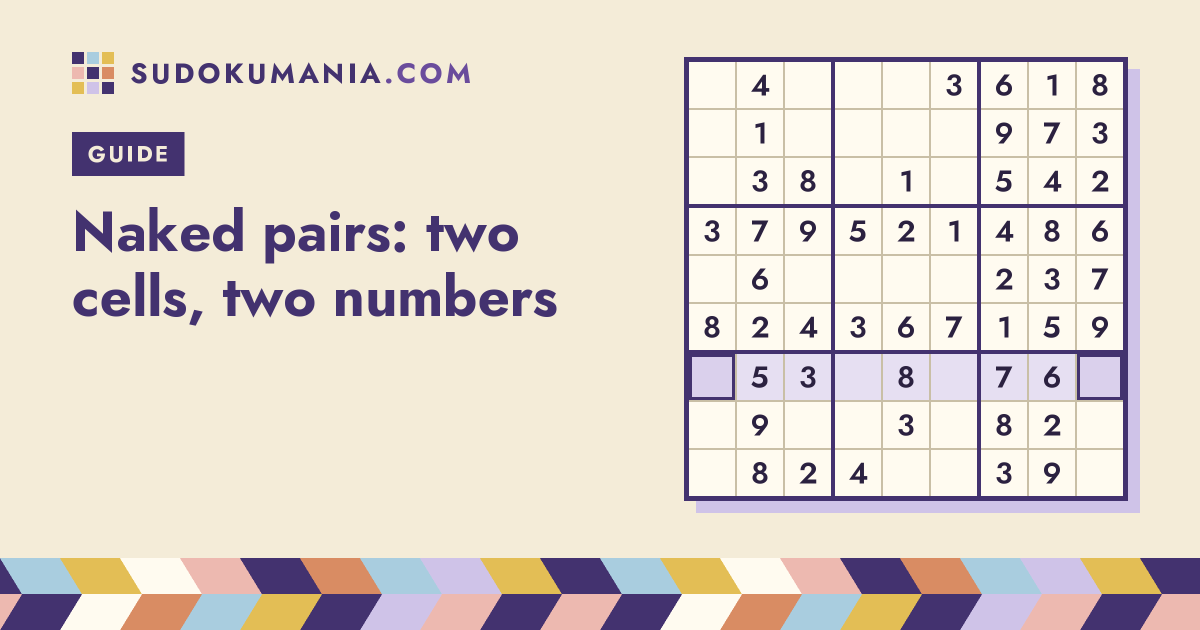
In hard sudoku there comes a moment when the singles and the intersections, that is the pointing pair and box-line reduction, find nothing more. The technique to try then is the naked pair. It doesn't ask where a number can go, but the opposite: which numbers a cell can hold. That's why it's easy to see with pencil marks. And like the intersections it doesn't write a number: it removes some from other cells.
The idea
Suppose that in a row two empty cells can only hold the 3 and the 8: both of them, and no other number. You don't know yet which of the two will get the 3 and which the 8, but one thing you already know: the 3 and the 8 of that row will be in those two cells, one each. So in the other cells of the row neither the 3 nor the 8 can go, and you remove them from their notes.
It's called “naked” because the two cells have nothing else: two cells, the same two numbers, no third candidate. It works the same way in a column and in a box. And if the two cells are in the same row and in the same box, you remove the two numbers from both units.
The two cells must have exactly the same two candidates. A cell with the 3 and the 8 and another with the 3, the 5 and the 8 aren't a naked pair: if the 5 goes in the second one, one of the two numbers is free to go elsewhere in the row.
A step-by-step example
Here's how you get there:
- Write the notes of the row you're looking at. In every empty cell mark the numbers that aren't already in its row, its column and its box. Without notes the naked pair is hard to see: to say that a cell can only hold two numbers you must have ruled out the other seven.
- Look for the cells with only two notes. They're the ones you notice first, and every naked pair starts from one of them.
- Look in the same unit for another cell with the same two notes. The same ones, not just one in common: the 3 and the 8 with the 3 and the 8.
- Remove the two numbers from the other cells of the unit. Erase their notes in all the empty cells of the row, except the two of the pair. If the two cells are also in the same box, do the same in the box.
The elimination alone doesn't fill any cell, but it often gets close. A cell that had the 3, the 8 and a third number among its notes is left with that one alone: it's a naked single. Or a number is left with only one place in the row, or in a box: it's a hidden single.
In a box
The naked pair doesn't live only in rows and columns. In a box you look for it the same way, and there the two cells are close together: the eye finds them quickly.
Look at where the two cells of the figure are: they're also in the same row. Then the pair counts twice, and the two numbers are also removed from the other cells of that row, wherever they appear. The figure shows the notes only in the box, but in the row you do the same.
Without notes
You can, but it's hard work: for every cell you have to count in your head the numbers that the row, the column and the box rule out. There's one case, though, that you can see even without notes. If a row is missing only two numbers, its two empty cells can only hold those: they're a naked pair by necessity. In the row there's nothing to remove, because it has no other empty cells. But if the two cells are in the same box, you remove the two missing numbers from the rest of the box. The same goes for a column.
In this case, if you look closely, it's also a box-line reduction for each of the two numbers: two different roads, the same result.
To spot it quickly
- After every elimination look at the cells that lost a note: the ones left with two notes are the first that can form a pair.
- Look first in the units with few empty cells: with four or five empty cells the notes can be compared in a moment.
- Look at all the units the two cells share: two cells of the same row can also be in the same box, and then the elimination counts twice.
- After the pair go back to the singles: that's usually where the new number turns up.
The most common mistakes
- One note in common, not two. The 3 and the 8 in one cell, the 3 and the 5 in the other aren't a pair: you need the same two notes in both cells.
- Notes that aren't up to date. A missing note makes you see a pair that isn't there, and the elimination that follows is wrong. Before removing anything, check the two cells again against their row, their column and their box.
- Removing the numbers from the cells of the pair. There they stay: one of the two will hold the 3, the other the 8.
- Removing them outside the unit. The pair only counts in the row, the column or the box the two cells share. Two cells of the same row, in two different boxes, say nothing about those boxes.
- Three cells with the same two notes. In the same unit it can't happen: three cells can't share two numbers. If you find it, there's a mistake further back, a wrong digit or a note erased by mistake: go back and check.
The same reasoning works with three cells and three numbers: it's the naked triple, and it's the next step.
When you need it, on Sudokumania
Our solver, at every step, tries the techniques from the simplest: first the singles, then the intersections, then the pairs, the triples and the others. The naked pair is the first one it tries after the intersections. A sudoku is hard when, to solve it, the solver uses a technique from this group at least once (pairs and triples, naked and hidden, the X-Wing and the Swordfish) and nothing harder. In easy and medium sudoku the naked pair is never needed: the singles and the intersections are enough. In hard ones it's the first to look for when the intersections find nothing more.
More guides
- Scanning (cross-hatching): the first sudoku technique Scanning, or cross-hatching, is the technique that solves almost every easy sudoku. How it works, a real example and how to do it quickly. Easy
- Naked single and hidden single: the two moves behind every sudoku A number is forced in two ways: the cell admits no other, or the number has no other place in its row, column or box. Here's how to spot them. Easy
- Pointing pairs and triples: the first technique of medium sudoku If a number in a box can only go in one row or column, you remove it from the rest of that line. How to spot it, with two real examples. Medium